CASE STUDY · EST. 2011 · APAC
A 12-month HR documentation backlog, done in 3 months. Sport Australia's HR team ran it themselves.
The Situation
Sport Australia engaged ZXM to design and embed an agile operating model inside their HR Department, using a large-scale enterprise agreement renewal as the proving ground.
The IT Department had already completed an agile transition with ZXM. Lead times dropped and throughput lifted by 200%. HR leadership had watched that happen. When they were handed responsibility for updating the entire suite of staff policies — pay, leave entitlements, career progression, and working conditions for all employees — their original forecast was twelve months. They asked ZXM whether agile could compress that significantly.

The enterprise agreement had been finalised, approved, and signed off — a five-year wage and conditions contract covering all staff. The written policy suite underpinning it needed a complete update before the new arrangements could take effect. The HR team was expected to do this while maintaining full service delivery to the organisation. There was no pause in recruitment, onboarding, or advisory support while the documentation work ran.
What the diagnostic found
Before any new working model was designed, ZXM mapped the full inventory of work the HR team was carrying — both the policy documentation task and the ongoing operational load. The picture was immediate: the department had no shared visibility of what was in flight, no mechanism for making deliberate trade-offs between work types, and no structure for distinguishing time-sensitive tasks from plannable ones. Every item competed equally for attention. Nothing was prioritised systematically.
Two conditions were producing the twelve-month forecast. First, the team was treating the documentation work as a single, undifferentiated mass — which meant stakeholders had no way to know when anything would be ready, and the team had no way to build toward partial delivery. Second, HR’s service obligations were absorbing capacity unpredictably throughout the week, leaving the documentation work to be picked up in gaps rather than planned for explicitly.
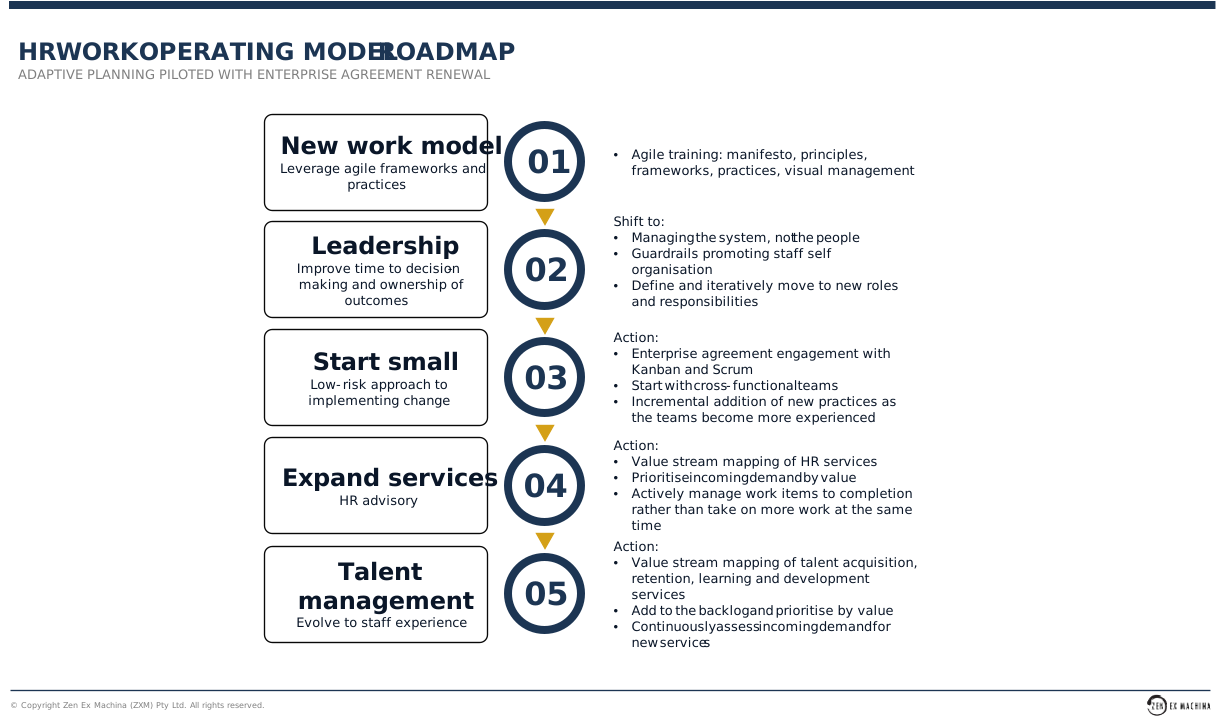
The fix was not a methodology. It was a structural separation: make the work visible, give it a priority order, and protect enough planned capacity to make consistent progress. Kanban gave the team a real-time picture of all work in flight, including the operational service queue. Once the bottlenecks were visible, ZXM worked with HR leadership to assess how much new documentation work could run in parallel with existing obligations without degrading service.
What changed
The team got a shared visual board showing the full in-flight state — both the operational service queue and the documentation backlog — for the first time. ZXM worked with HR leadership to sequence the documentation by cost of delay. Policies affecting pay and leave conditions were prioritised ahead of procedural updates, because the cost of staff receiving incorrect information about their entitlements was the highest-consequence risk in the suite. Lower-priority items were placed explicitly in the backlog and given a visible sequence, which allowed leadership to give staff realistic estimates of when each piece would be available.
A weekly planning rhythm was introduced to protect dedicated blocks for documentation work while keeping capacity for just-in-time service requests. Scrum’s events gave the planned work structure: a weekly goal, a daily check on progress, and a stakeholder review at week’s end. That review loop produced something the original twelve-month estimate had not accounted for — early feedback. Staff and managers were able to flag errors and ambiguities before the full suite was complete, which reduced downstream rework and compressed the overall cycle further.
Prioritisation was anchored to cost of delay — the economic cost of not having each piece of documentation available to staff. Reinertsen (2009) describes cost of delay as the single most important variable in sequencing knowledge work, because it makes the trade-off between competing items explicit rather than political. For HR, this translated directly: work that affected pay and entitlements carried a higher cost of delay than process documentation, because the consequences of staff acting on incorrect information were immediate and organisation-wide.
What held
The first sprint produced signed-off, publication-ready documentation. The entire policy suite was complete in three months. Throughput across the HR team increased by 200% over the engagement period — the same lift the IT Department had achieved, now replicated in a function where iterative delivery had not previously been tested.
Kanban and the weekly planning rhythm remained in use across HR’s full operating cycle after the enterprise agreement work was complete — applied to recruitment, onboarding, and ongoing staff support. The structural separation between plannable work and just-in-time service requests was the mechanism that made both streams manageable. Continuous improvement became a working practice rather than a stated intention, because the weekly review created a regular, low-friction point for the team to surface process friction and address it.
The capability built during the engagement was not dependent on ZXM’s continued presence. HR leadership owned the board, the prioritisation logic, and the rhythm by the time the documentation work was complete.

3 months, not 12
The full policy suite was signed off and available to staff. First sprint produced publication-ready documentation.

Full work visibility
A shared Kanban board gave HR leadership a real-time view of all in-flight work for the first time — operational and project load visible together.

200% throughput lift
Department-wide output doubled over the engagement period — matching the result achieved in IT, in a function new to iterative delivery.