The steering committee report is positive. Adoption metrics are tracking. The named use cases are progressing. The investment paper that went up six months ago is still substantively true at the level it was written. None of that is wrong. The executive sponsor reading the report has, by every measure the committee was set up to produce, a program that is working.
The instinct that something is off comes from somewhere else. It comes from a corridor conversation, a half-finished sentence at the end of a leadership offsite, the answer to a question the executive asked outside the reporting cycle. The floor-level account of the same program is not negative, and it is not in disagreement with the committee report. It is describing a different program.
Two coherent accounts of the same program produce one blind spot
The divergence is not a reporting failure, and it is not an alignment problem in the conventional sense. There is no internal conflict to resolve and no faction to bring on side. The committee’s account holds together on its own terms; so does the manager’s. What they do not do is line up. The committee is reading the strategy as it advances, while the manager is reading the tools as they do or do not fit the actual shape of the work in front of them.
According to Korst, Puntoni and Tambe in the Harvard Business Review (April 2026), middle managers are 64% more likely than senior colleagues to describe themselves as cautious about AI progress (Korst et al., 2026). The Wharton School researchers behind the study point to a mechanism worth naming: the senior view tracks the program against its stated objectives; the middle view tracks it against the texture of the work it is meant to change. Both groups are competent observers of what they are looking at, but they are looking at different surfaces.
This is the perceptual split, and it is the mechanism by which AI investment value is lost. It is not a symptom of a loss occurring elsewhere; it is the place the loss occurs. Value goes in the gap between the committee’s reading and the floor’s reading because that is where the cost of misfit gets absorbed silently. Workarounds get built. Tools get used for a narrower task than was envisaged. Time gets spent restoring the part of the workflow the new tool was meant to replace. None of that surfaces on the steering committee dashboard, because the steering committee dashboard was not designed to detect it.
Opacity that looks like control
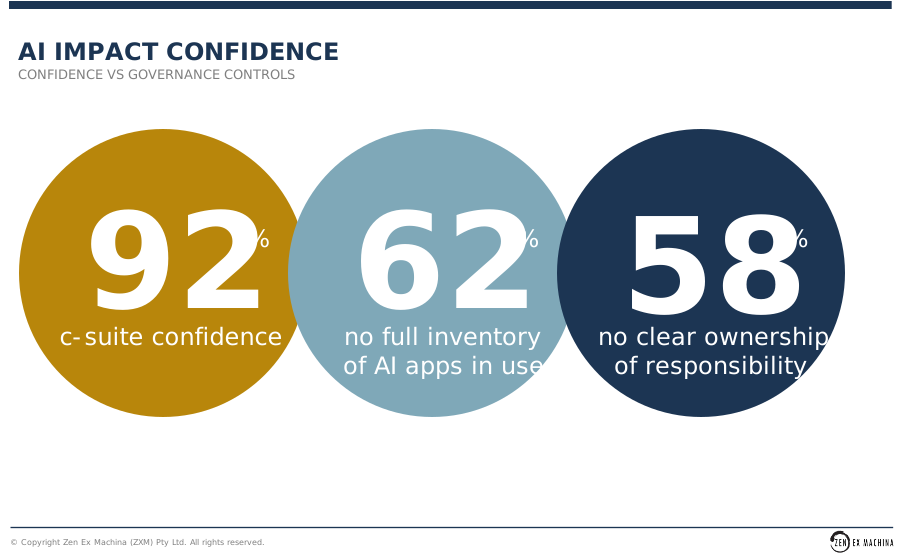
The split persists because the conditions allowing it to persist are conditions that look like control. A February 2026 study of senior leaders published via BusinessWire (Larridin, 2026) found C-suite confidence in AI impact sitting at 92%, while 62% of the same organisations did not have a full inventory of the AI applications in use, and 58.2% reported no clear ownership of AI as an organisational responsibility. The confidence is genuine. So is the opacity. They are not in tension because the confidence is built on the layer of the program that is well-instrumented, and the opacity sits at the layer below it.
The Grant Thornton 2026 AI Impact Survey, drawing on responses from approximately 950 senior executives, is the sharpest reading of where this lands inside the C-suite itself. Chief Information Officers and Chief Technology Officers were five times more likely than Chief Operating Officers to say their workforce was fully ready to adopt AI — 39% versus 7% (Grant Thornton, 2026). The technology-accountable executives are reading their own delivery of capability. The operations-accountable executive is reading what happens on the receiving end of that capability. Each number is accurate to what each executive can actually see, but neither is the whole picture. The committee that aggregates them produces a confidence figure that no single executive on the committee would, in isolation, defend.
This is why a program with positive committee reporting can be quietly accumulating the conditions for a performance shortfall that will eventually arrive in a quarter where it cannot be explained from the materials the committee has. The materials were not wrong. They were a faithful account of the layer they were built to describe.
Sponsors see only half the program
If the diagnosis is correct, the executive sponsor’s position is not the one the committee paper suggests. Closer to the truth: the program has a confidence reading at one level and an unread reading at another, and the executive is currently working with the first of the two. The unread reading is where the cost of misfit is currently being absorbed, and the cost is not yet in the metrics because the metrics do not look there.
What compounds the problem is what happens across several reporting cycles. Each cycle in which the floor-level account is unread is a cycle in which workarounds get codified, the gap between the named use case and the actual use becomes the new shape of the work, and the executive’s read of program value drifts further from the operational reality the value is supposed to derive from. By the time a performance variance shows up in a metric the committee tracks, the lag between cause and visible effect is already months long. The diagnostic conversation that would have been straightforward in the first quarter becomes a forensic one by the fourth or fifth.
The executive who senses the divergence early is reading something real. The instinct is not a worry to manage. It is a signal that the program has two accounts of itself, and the committee is reading one of them.
Only outsiders can read both accounts
The act this calls for is not a deeper version of the committee reporting. The committee is already reading what it is built to read. The act is an independent read of what the program looks like one level below the reporting cycle, before any performance signal forces the conversation, and while the question is still about what the program is rather than why it underperformed.
The independent read is not an audit. An audit asks whether the work conformed to what was specified. The independent read asks what the work has become in the hands of the people doing it, and whether the senior account and the floor account are describing the same program or two different ones. The output is not a finding against execution. It is a translation between the two coherent accounts the organisation is already producing.
Initiating that read is an act available only to the executive sponsor. The committee cannot initiate it without becoming the subject of it. The delivery partner cannot initiate it without becoming the assessor of their own work. The sponsor sits in the only position that can both see the committee’s account and ask for the floor’s account to be read alongside it.
The executive who reads both accounts of the program before the gap between them becomes the explanation for a number is working with a different program eighteen months later than the executive who reads only the one the committee was built to produce.
Five actions for senior leaders
- AI steering committee oversight is not a single account of the program; it is the senior account, and it is reliable for what it is built to read. The floor-level account is the other half, and it is currently unread.
- The point of value loss is the gap between the two accounts, not a problem inside either one. Workarounds, narrowed use of tools, and restored manual workflows accumulate in that gap and do not appear on the committee dashboard until they show up as a performance variance one to two quarters later.
- The executive sponsor is the only role that can initiate an independent read without compromising the read. The committee cannot assess itself; the delivery partner cannot assess its own work.
- The window in which the divergence is cheap to close is the window before a performance metric forces the conversation. After that, the question shifts from what the program is to why it underperformed, and the diagnostic conversation becomes a forensic one.
- End-of-cycle is the natural prompt. Acting on the instinct of divergence before the next reporting cycle closes is the act that converts a felt signal into an operational read while the cost of correction is still measured in weeks, not quarters.
References
- Grant Thornton. (2026, April 13). A widening ‘AI proof gap’ is emerging, but well-governed AI is showing results [Press release]. Grant Thornton LLP.
- Korst, J., Puntoni, S., & Tambe, P. (2026, April 8). Managers and executives disagree on AI — and it’s costing companies. Harvard Business Review.
- Larridin. (2026, February 3). New study shows C-suite leaders highly confident in AI ROI even as 58% claim there’s no clear ownership of AI and 75% lack AI governance [Press release]. BusinessWire.


