Capability Building · 200% Operating Model · EST. 2011 · APAC
The Australian Taxation Office engaged ZXM to lead its IT transformation to a product-operating model, focusing on its first SAFe Agile Release Train for Priority Digital Services (PDS) Release Train. At that time, the program spanned 120 people and high-risk work impacting Australia’s tax submission periods. ATO needed support for improving its operations in a way that would “stick” and not disrupt delivery.
The PDS Branch operated predominantly as a traditional MSP / PRINCE2 program. People and work were managed through traditional functional silos. Role gaps, integration gaps, and geographic splits meant the program was more a collection of people than a coordinated delivery system.
At the program layer, a Waterfall management approach was in place. There was no shared view of progress, no lean thinking applied to prioritising work, and no clear ownership of the product as a whole — teams escalated upward rather than resolving problems laterally, with a tendency to conceal issues rather than surface them.
Engineering practices were strong but largely not scalable or repeatable: no continuous integration techniques, inconsistent tooling across teams, and environment provisioning running on legacy timelines. Where agile frameworks had been introduced, multiple competing interpretations had taken hold with no single operating model applied consistently. Some teams had learned the mechanics of Scrum — the terms and some artefacts — but had not internalised what the shift in accountability and self-management actually required.
Before any coaching intervention was designed, ZXM mapped the behavioural and structural conditions needed to establish an Agile Release Train. The primary finding: teams understood what Scrum events required of them procedurally, but not what the shift in mindset and accountability actually meant in practice. Without making that distinction visible, coaching efforts would produce process compliance rather than capability.
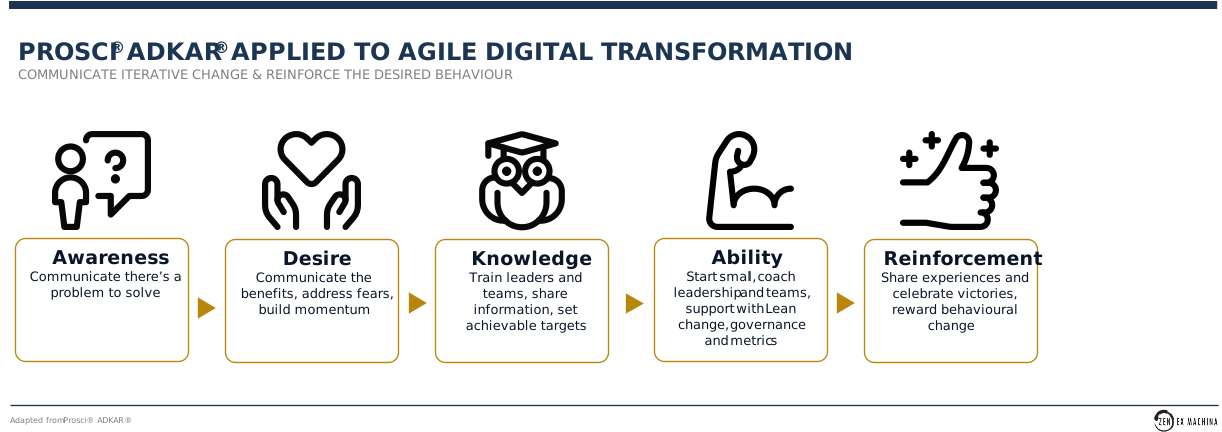
ZXM developed a living coaching roadmap that named the behavioural stages of the transition from Waterfall to Scrum and Lean as observable, assessable milestones. This gave teams, Product Owners, and Scrum Masters a shared language for where they were and what was expected next, independent of coaching presence.
The roadmap promoted transparency across the Release Train. Teams, their Product Owners, and Scrum Masters could continuously assess what agile behaviours they were sustaining without coaching support, what their next capability development looked like, and what an agile mindset meant beyond the mechanics of running a Sprint.
Training ran first. ZXM delivered a one-day Scrum essentials session that combined framework instruction with game-based simulation, designed for rapid assimilation rather than credential acquisition. Over twelve months, ZXM coaches trained more than 150 people across the Release Train — executives, business owners, stakeholders, managers, and Scrum team members. The same session was adapted as the teams scaled, so new entrants could be onboarded without halting delivery.
One ZXM coach embedded directly to enhance product ownership. They worked through the disciplines of backlog management, prioritisation, refinement, Persona-based story mapping, and cross-team alignment in the daily Product Owner sync between the Programme Manager and the Release Train’s Product Owners. The focus was on building decision-making discipline, not on facilitating meetings. A recurring Product Owner-specific retrospective provided the cohort with a structured space to examine delivery patterns, share failures, and refine practices across teams — without ZXM as the intermediary.
Feature delivery volume doubled. Within twelve months, the PDS Release Train increased throughput by 200%, reduced defects by 90% within nine months, and onboarded 80 people in 8 weeks without measurable loss of velocity. The coaching model was designed to make itself redundant: by the time ZXM’s engagement concluded, teams were running retrospectives and the Product Owner sync without facilitation support. The capability had transferred.
Onboarded and trained without loss of delivery velocity
Features delivered doubled in 12 months
Defect rate cut within 9 months