Last year’s business case for replacing staff with AI promised that a smaller team of assessors, with an AI service doing the routine work, would cut the cost of each transaction. In the first year it delivered: the finance report shows the salary line down by more than the licence fee added, and the cost per processed item lower than it has ever been.
In Brief
- Replacing staff with AI cuts each task's cost in year one and leaves customer waiting times unchanged.
- AI speeds up work inside functions and does nothing to the hand-offs between them, where requests wait.
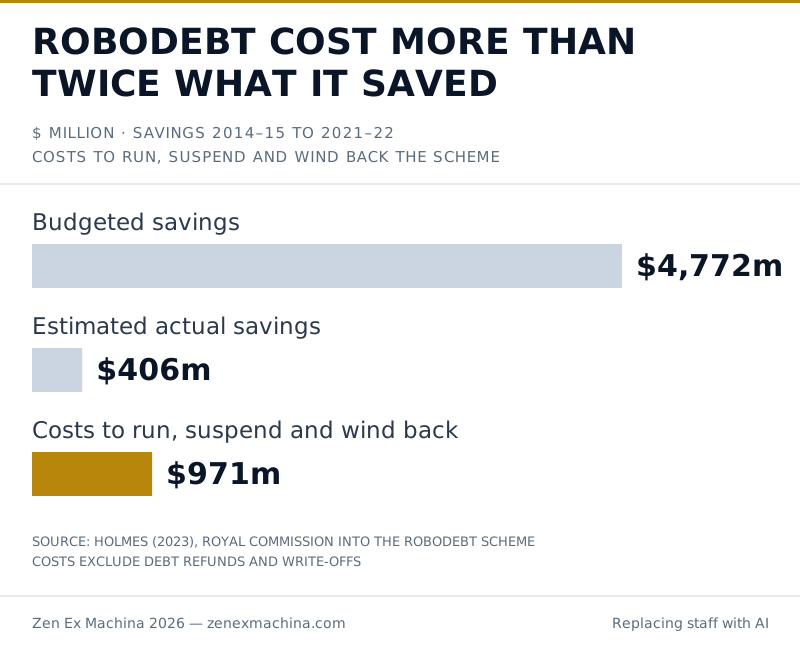
- Australia's Robodebt scheme planned to take reviews online, needed staff for 93% of them in 2017–18, and saved $406 million against $971 million in costs.
- Routine work handed to AI was where junior staff learnt the judgement needed for cases AI cannot resolve.
- Approving an AI business case is the only point where asking what each role did besides its task still changes the decision.
Over the same year, the time a customer waits for an answer has not changed. Requests still sit for days before anyone with authority to act looks at them. The senior staff who remain spend their week checking AI output and handling the exceptions the system cannot resolve, and the list of open exceptions is longer than it was before the change. Both figures are accurate, because one measures the cost of a task and the other measures how long the customer waits for an outcome.
Faster tasks still wait in queues
In an organisation built around functions, every hand-off adds a wait that no one’s task time measures. A request moves from intake to assessment to approval to the team that acts on it, and at each boundary it waits for someone with the authority to move it on. When the active work shrinks and the waiting stays the same, the organisation gets faster components and the same slow outcome.
AI speeds up the work inside each function and does nothing to the hand-offs between them.
AI agents reproduce the effect with no people involved. In a 2026 study, four agents running the same model worked on one programming task under two designs. With a main agent handing out the work and relaying results, 44% of agent time went on waiting. With the agents sharing their progress directly, waiting fell to 2% and the task finished 5.5 times sooner (Mao et al., 2026). The researchers trace the difference to the central relay, where agents waited for results to be passed back instead of building on each other’s work.
Cutting staff moves the people who remain into the queue. Someone still has to approve what the AI produces, and that person’s capacity is fixed while the AI’s output is not. When Anthropic studied its own workforce, interactive Claude sessions spent around 80% of their time idle, waiting for human input (Wilmers et al., 2026). Reading all the output of their agents would take even non-technical employees half their working week. Where a review step sits after every AI output, the reviewer sets the pace of the whole process, and the reviewer is now the most experienced person left.
Automated errors come back as work
Automating a process that already makes mistakes produces those mistakes at the volume the automation runs at. Wrong decisions return as disputes and review requests that people have to handle. Australia’s Robodebt scheme was a Budget measure whose predicted savings depended on removing compliance officers from most of the work of raising welfare debts, with almost every review planned to happen online. In 2017–18, 93% of reviews were completed with a staff member’s help, and the department had engaged 580 temporary workers on six-month contracts, followed by a labour-hire workforce of about 1,000 (Holmes, 2023).
The scheme was budgeted to save $4.772 billion. It is estimated to have saved $406 million, against costs of $971 million to run, suspend and wind back. The Royal Commission called it “a crude and cruel mechanism, neither fair nor legal”, and found that removing the human element was a key factor in the harm it did (Holmes, 2023).
Robodebt used rule-based automation, not AI, and its debts were unlawful as well as inaccurate. AI runs the same sequence faster, executing a flawed process at a volume no review team was sized for. The people the business case removed from the work become capacity the organisation has to buy back, on short contracts and through labour hire, as that department did.
Savings estimates ignore a role's other work
The approval process measured what finance can see: salary is a line item, and so is cost per transaction. The days a request spends between functions appear on no ledger, because the accounting system records effort and has no line for the time work sits idle. A change that cuts effort shows as a saving, while the waiting it leaves in place and the rework that arrives a year later stay out of the report.
The same business case treats each role as a cost line and does not ask what else the person in that role was doing. The assessor working through routine files was also the person who noticed when a run of decisions looked wrong and took it to someone who could change the rule. That second job was never costed, so the savings estimate treated it as free to remove.
Boston Consulting Group’s 2025 survey of 1,250 senior executives found that about 60% of companies report minimal revenue and cost gains despite substantial investment in AI (Boston Consulting Group, 2025). For those companies, whatever was saved on individual cost lines did not add up to a gain the organisation could report. The people who approved last year’s business case acted on the evidence they had, and that evidence did not include the second job each role was doing.
Routine work was where judgement grew
The slowest cost to appear takes a career stage to arrive, because the routine work AI took over was also where junior staff learnt the job. People learn a profession by taking part in real work alongside experienced practitioners (Lave & Wenger, 1991). A junior assessor learns that a clean-looking file is wrong by watching a senior colleague stop on it and ask a different question. When the routine files go to the AI, the junior staff who remain spend their early years checking AI output instead of making the decisions themselves. At Anthropic, the share of junior employees in technical departments has fallen from 21% to 14% since early 2025 (Wilmers et al., 2026). The same researchers report that in some roles employees are increasingly removed from the hands-on work that originally built their skills.
That judgement is what the organisation needs for the cases AI cannot resolve, where legitimate objectives conflict and there is no precedent to match against. The senior assessor the organisation will need next is the mid-level staff member being developed now. Each year the routine work stays automated with nothing in its place, another intake of practitioners reaches the middle of their career without having made the decisions that build that judgement. Over the same years, the experienced people who can resolve such cases retire. The shortfall becomes visible long after the decision that caused it, well beyond the horizon of the business case that approved it.
Roles did more than their tasks
The question that changes the business case comes before the headcount decision: what was this role doing besides the task being automated? The person was moving work and exceptions across a boundary, and they were building the judgement the organisation will need next. Both need a deliberate replacement before the role goes.
Answered at investment approval, that question makes the time from a customer’s request to the outcome the speed measure, in place of the processing time of a task. Human review moves to the point where a wrong decision cannot be undone, instead of sitting after every output, and the process is fixed before it is automated. The development the routine work provided becomes a deliberate pathway, with one accountable owner, funded in the same decision as the automation and running before the routine work is removed. Redesigning the work goes with more AI in use. Against the laggards in Boston Consulting Group’s survey, the 5% of companies it calls future-built have five times as many AI workflows deployed or scaled, and put 2.5 times the focus on reshaping and inventing workflows with AI (Boston Consulting Group, 2025). Adoption and redesign belong in the same decision, because the judgement needed to govern the AI is learnt on the work the AI is replacing.
Redesigning around the outcome is harder to approve than a headcount reduction, because the cost it prevents does not appear in the year the saving is booked.
What this means for senior leaders: Replacing staff with AI lowers the cost of each task in the first year and leaves the time to an outcome unchanged, because the waiting happens between functions. Over the following years, review work and the errors of any flawed process come back as work for people the organisation has to keep or hire back. Later still, the routine work that trained the next senior generation stops doing so. Each of these costs is set when the business case is approved, which is the only point where asking what each role was doing still changes the decision.
An AI service cuts the cost of a task on the day it goes live. The saving lasts, and the organisation becomes faster, only when the hand-offs and the review point are redesigned around the outcome the customer is waiting for, and it stays capable only while its people are still learning the judgement the AI cannot supply.
References
- Boston Consulting Group. (2025). The widening AI value gap: Build for the future 2025. Boston Consulting Group. https://media-publications.bcg.com/The-Widening-AI-Value-Gap-October-2025.pdf
- Holmes, C. (2023). Report of the Royal Commission into the Robodebt Scheme. Commonwealth of Australia. https://robodebt.royalcommission.gov.au/publications/report
- Lave, J., & Wenger, E. (1991). Situated learning: Legitimate peripheral participation. Cambridge University Press. https://doi.org/10.1017/CBO9780511815355
- Mao, Y., Gu, J., Chauhan, A., Zhang, Q., Kang, H., & Mirhoseini, A. (2026). Decentralized multi-agent systems with shared context (Version 3) [Preprint]. arXiv:2606.10662v3. https://arxiv.org/abs/2606.10662v3
- Wilmers, N., Catipon, R., Massenkoff, M., & McCrory, P. (2026, October 16). How employment is changing at Anthropic. The Anthropic Institute. https://www.anthropic.com/research/employment-at-anthropic


