CASE STUDY · EST. 2011 · APAC
AUSTRAC delivery cycle cut by 91%
The Situation
AUSTRAC engaged ZXM for an independent diagnostic of a regulatory technology transformation that was two years into delivery and visibly behind. The leadership team had already done the hard thing: acknowledging that what governance was hearing and what delivery was doing had drifted apart. The CIO and Program Director sought an independent assessment to improve the program and achieve its strategic outcomes within the remaining time and budget.

The program had been chartered to replace the core regulatory infrastructure on which AUSTRAC’s external obligations depend. Seventeen functional concepts sat on the roadmap. Two years in, only four had shipped. The slowest delivery cycle had stretched to 241 days from concept to working capability. At that pace, the remaining thirteen concepts were forecast to be completed in six years. The program did not have six years to spend, and the external timeframes were fixed.
What the diagnostic found
The diagnostic ran for several weeks and read the programme from three angles: how delivery was structured, how governance was structured, and how the operating model linked the two. The inquiry was structural; it was looking for the system condition producing the delay, not the team behaviour presenting as the symptom.
The primary finding centred on the program’s choice of operating model. The delivery teams were capable, and the technology choices were sound, but handoffs between business engagement, definition, design, and execution significantly slowed delivery. Every Feature paid the same structural tax, which is why the 241-day worst case was no outlier. The system was performing exactly as designed but the consequences of a linear, functional and siloed approach to delivery was never considered.
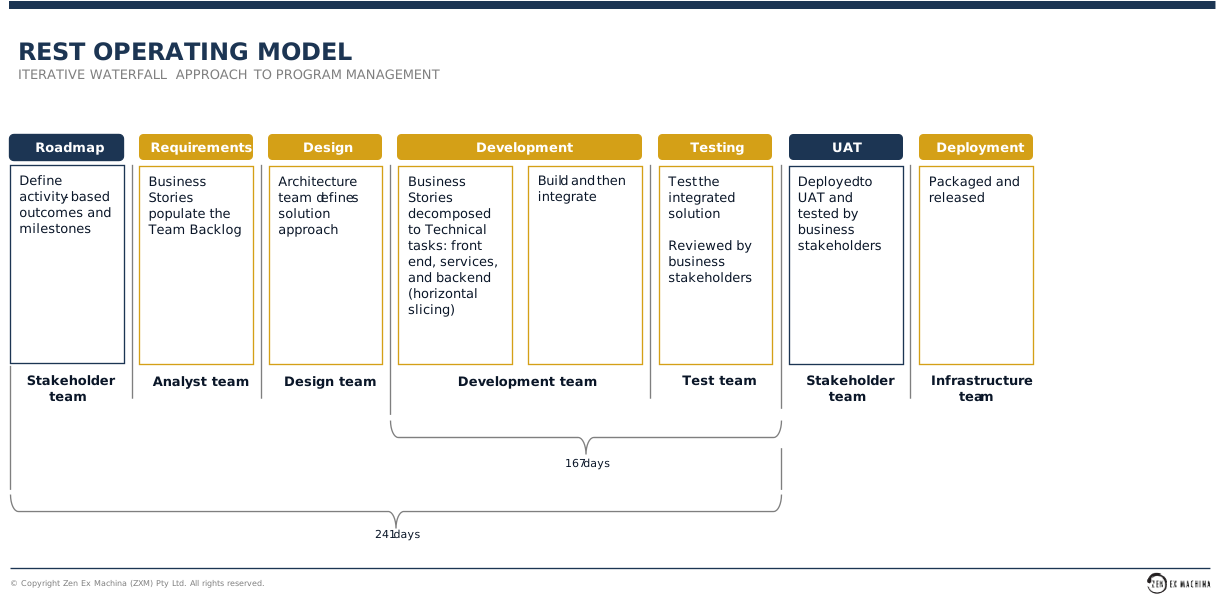
Three structural conditions produced that outcome.
1. Business stakeholders queued every Feature
Features were approved individually rather than as part of a backlog aligned with the roadmap’s strategic contribution. Every Feature was worked on regardless of relative value or readiness.
2. Functional handoffs prevented end-to-end throughput
Work moved through distinct functional stages in sequence: business engagement, definition, design, and execution. Each handoff added waiting time. Team-level task prioritisation created localised optimisation at the expense of strategic value and overall delivery time.
3. Activity reporting obscured the delivery trajectory
Status reporting measured activity rather than throughput, which meant every report could be honestly green while delivery stayed flat. The program board of National Managers had no mechanism for reading the underlying trajectory until the gap was already large.
What changed
AUSTRAC’s leadership chose to act on the diagnostic. They asked ZXM to lead the course correction and the capability development that would make it stick. The sequence is worth flagging: the diagnostic was the entry point, and the decision to extend the engagement came from the client after we delivered the findings. ZXM did not arrive with a remediation programme to sell.
The intervention began with the operating model, then moved to the delivery system, then to the reporting architecture. Governance was redesigned to approve Features as a pipeline rather than one by one, so the queue dissolved and Features could move when they were ready, not when the next monthly governance forum met. Integration and assurance moved upstream, which built quality into the cycle rather than catching it at the end. The delivery teams were reorganised around end-to-end value rather than functional specialties, removing five of the eight handover boundaries outright. The reporting architecture shifted to measures of what was actually delivered, giving the governance forum its first honest view of the underlying trajectory.
Coaching ran alongside the structural change. Teams learned to work in the new model while the model was being built. Leaders inside AUSTRAC took on the operating-model stewardship role that ZXM had been holding, so that when ZXM left, the model had a permanent owner who understood it from the inside. Stewardship sat with the people who would live with the consequences, which is why the new way of working took root rather than reverting once the engagement closed. The point of the engagement was always to make ZXM unnecessary.
What held
Delivery cycle time fell from a 241-day worst case to a 15-day average within the engagement, a 91% reduction. Feature throughput moved from one per quarter to six per quarter, a sixfold increase in delivery rate at the level that matters to AUSTRAC’s external obligations. Cost per Feature fell from $750,000 to $250,000, a 73% reduction. The forecast to complete the remaining concepts was halved, bringing the programme back within the timeframe required by its external obligations.
Product-level governance kept approving the pipeline after ZXM left. Reporting kept surfacing the underlying trajectory rather than the activity layer above it. The internal leaders who had taken on stewardship continued to steward. When the next set of Features moved through the system, they did so at the new cadence and did not revert to the old one.
AUSTRAC did not have a delivery problem; AUSTRAC had an operating model producing exactly the outcome it was designed to produce. The constraint was structural, the diagnosis was independent, and the course correction held because the operating model that produced the problem was the thing they changed. That is the part most programmes leave alone, and it is the part that decides whether the gains stay.

91% delivery cycle reduction
From features in 241 days to releasable features every 15 days

6x throughput
No increase in headcount, just more efficiency, less waste, greater focus

73% cost reduction
Emphasis on improved quality reduced defects and the overall cost to produce features