CASE STUDY · EST. 2011 · APAC
Four adopter groups. Two divisions. 3x productivity — no added headcount.
The Situation
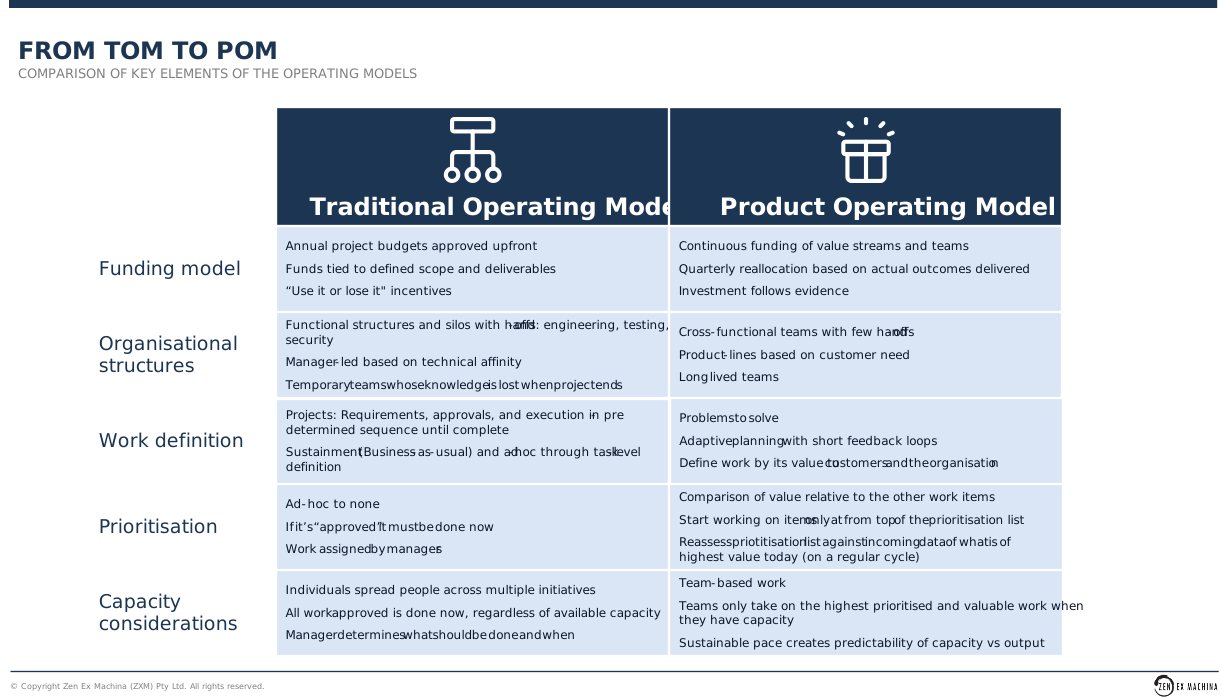
The department engaged ZXM to design a Product Operating Model (POM) for IT — a model that would govern how software, hardware, data, and cloud teams managed their products across two major divisions. The engagement spanned four early-adopter groups, covering diverse product contexts, from general application development to AWS PROTECTED cloud infrastructure.

The POM needed to be more than a document. It needed to scale — from small teams working on complex physical products to large software and data and traditional infrastructure — and adapt to the radically different operating realities of each group. ZXM was commissioned to produce, test, and iterate the model within 12 weeks.
What the diagnostic found
ZXM began drafting the POM and conducting structured design workshops in parallel with four early-adopter groups. The goal was not to validate a predetermined model. It was to map how each group actually worked — what decisions were made, by whom, and how accountability for product outcomes was currently distributed.
Several structural conditions emerged consistently across the groups.
- Core concepts of product ownership were nominally assigned but not functionally supported — teams lacked the decision governance and formal agreed prioritisation mechanisms to act on them.
- Traditional hierarchical, centralised governance dominated decision-making.
- The prioritisation and demand management was largely project-oriented: work arrived as requirements rather than problem statements, which prevented triage and value-based sequencing.
- The current operating model lacked portfolio feedback mechanisms — there were few structured feedback loops from delivery back to strategic investment decisions.
These were not problems of individual capability. They were conditions of the operating design.
What changed
ZXM used a multi-agent AI system (MAS) with strong governance controls to accelerate the aggregation of current industry best practices, drafting, peer review for consistency and alignment, iteration of feedback, and version control for the POM — compressing a three- to nine-month engagement into eight weeks of initial production. A further four weeks were dedicated to structured feedback cycles with each adopter group, testing the model against their specific context.
Workshops
Hands-on workshops were run across the two divisions. Each session served two purposes: to elicit contextual feedback on how the model needed to evolve, and to verify that the model was genuinely scalable — that a single framework could govern software teams and hardware teams, small specialist groups and large product lines, without requiring significant customisation.
Solving 'oversubscription' and resource constraints
Like many other Branches, the cloud product line operated in a severely resource-constrained environment. This problem was compounded by the need to complete existing projects vs service delivery expectations and the needs of external teams undertaking migration activities.
Early transparency of demand quickly produced insights of capacity versus demand and how, without increasing the existing headcount, more work could be delivered with a cross-functional team based approach driven by value-based prioritisation.
What held
The AWS PROTECTED cloud team had been working with a ZXM strategic advisor prior to POM on using a product model to manage the cloud. As early adopters, they saw a threefold increase in productivity. In a resource-constrained environment where additional headcount was not an option, the model created the governance conditions for the same team to achieve substantially more.
The early adopter workshops validated scalability — the model operates effectively across software, hardware, data, and cloud product contexts without requiring bespoke redesign for each. The feedback cycle from each group has been built into the ongoing iteration cadence, so the model will continue to evolve as adoption matures.
A product operating model that cannot adapt to context will fail at the first divisional boundary. This one held because the adaptive surface was designed in, not added as an afterthought.
The results

3x productivity
AWS PROTECTED cloud team tripled delivery output — without additional headcount.

12-week rapid delivery
POM produced and iterated in 12 weeks. Conventional engagements of this scope take 3–9 months.

4 early adopters
Two divisions, four product contexts — software, hardware, data, and cloud — validated on a single model.