Midway through the Sprint, your test-generation agent starts writing test cases that skip the boundary conditions your Definition of Done requires. You catch some before they’re merged and miss others, because they look plausible. The agent works from a skill file, and your team has never agreed whether a Developer can edit the skill file or needs someone’s approval first. Someone has even proposed a central AI team to approve every change. The Scrum Guide already answers the question: the fix is yours, and it belongs in this Sprint.
In Brief
- The Developer who maintains an agent’s skill file fixes it when the agent’s output misses the Definition of Done.
- A skill file edit can be undone, so it sits inside the Developer’s authority. Releasing to production doesn’t.
- Fix the file in the Sprint you find the defect, then check the agent’s next output against the Definition of Done.
- Take repeated failures to the Sprint Retrospective, where the Scrum Master can check whether other Developers’ files share the gap.
The skill file fix is yours
The Scrum Guide makes the Developers accountable for instilling quality by adhering to a Definition of Done, and for adapting their plan each day toward the Sprint Goal (Schwaber & Sutherland, 2020). It also says quality does not decrease during the Sprint. When an agent writes test cases for you, its output is part of your work, so the gap in those test cases is yours to close.
In Paper 5 of the Empiricism at Machine Speed series, the skill files belong to the Scrum Team, and each Developer maintains the ones their own agents use, revising them when the output falls short (Hodgson & West, 2026b). Your authority stops at what the paper calls the irreversibility boundary: the point where a decision can’t be undone without disproportionate cost. Integrating a component into the team’s Increment is a Developer’s call, while releasing a breaking change to production goes to the Product Owner. A skill file edit can be undone, so it sits on your side of that line.
Paper 4 makes the Scrum Master the accountable owner of the team’s instruction set as a whole (Hodgson & West, 2026a). Paper 5 draws the line between the two: each Developer owns the content of their own skill files, and the Scrum Master is accountable for whether the files stay consistent with each other and with the Definition of Done (Hodgson & West, 2026b).
Paper 5 presents this model as a hypothesis with no operational evidence behind it yet (Hodgson & West, 2026b). The Scrum Guide part stands without it. A Scrum Team is self-managing, which means its members decide who does what, when, and how (Schwaber & Sutherland, 2020).
Fix the defect this Sprint
Contain the defect before you change anything. Stop merging that agent’s test cases without checking each one, and go back over the ones already merged. Work those tests were meant to cover can’t count as Done until they check the boundary conditions, and the Guide says an item that doesn’t meet the Definition of Done cannot be released or even presented at the Sprint Review (Schwaber & Sutherland, 2020). Containment has worked when nothing from that agent reaches the main branch unchecked.
Then read the skill file against the Definition of Done. A boundary condition that appears only as a preference, or only inside an example, is easy for an agent to work around. Write it as a rule every test case must meet, in the Definition of Done’s own words. Paper 5 counts knowing what makes a prohibition robust, where a preference can be worked around, among the skills Scrum Masters now need to coach Developers on their skill files (Hodgson & West, 2026b).
Check the model version as well. If the agent’s output changed while nobody edited the file, the provider may have changed the model underneath it. Paper 4 recommends recording the model version in each skill file and re-running a sample of recent work against the Definition of Done whenever the version changes (Hodgson & West, 2026a).
A rewritten skill file is rarely right the first time, so the fix isn’t finished when you save the file. Run the agent again on the stories where it failed and compare the new test cases with the Definition of Done. The fix has held when the boundary conditions appear in every case without you asking for them. Tell the other Developers at the next Daily Scrum what failed and what the agent produces now, since they may be planning around the same agent.
A change to the standard itself isn’t yours to make mid-Sprint. If the fix needs a boundary condition the Definition of Done doesn’t yet require, Paper 4 says the standard changes first, at the Retrospective, and takes effect from the following Sprint (Hodgson & West, 2026a). A team chasing a quality target that moves mid-Sprint can’t forecast its work. Bringing a skill file back into line with the Definition of Done you already have changes no standard, so it shouldn’t wait.
Approval queues keep the defect running
A central AI team that approves skill file changes turns a fix you could make this Sprint into a request in someone else’s queue. While it waits, the agent keeps writing test cases from the old file, and you check every one by hand. The reviewers see the file you submit. The evidence the change rests on is the test cases the agent wrote this Sprint, and those sit with you.
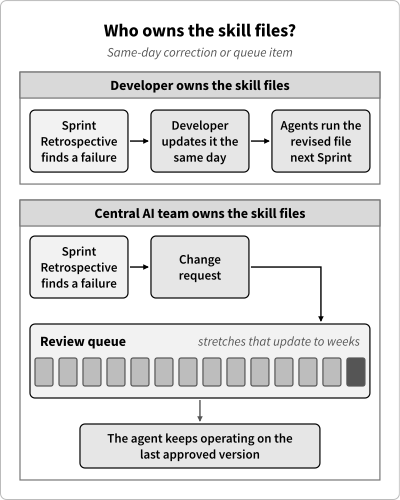
The Scrum Guide expects an adjustment as soon as possible to minimise further deviation, and notes that adaptation becomes more difficult when the people involved are not empowered or self-managing (Schwaber & Sutherland, 2020). Paper 4 gives a test for the mandatory approval checkpoints it finds in regulated AI workflows: is the checkpoint genuinely irreversible? Checkpoints that fail it consume time and add queue length without adding anything to the Increment (Hodgson & West, 2026a). Put an approval step for skill file edits to the same test and it fails, because you can undo the edit.
When a colleague asks who’s accountable for the agent’s output, the Guide gives you a one-sentence answer: the Developers are, through the Definition of Done they adhere to. That answer settles it in the Daily Scrum before it turns into a debate about governance.
Take repeated failures to the Retrospective
A failure that repeats across Sprints, or shows up in more than one Developer’s agents, points at an instruction. Paper 4 puts it this way: one Increment that misses the Definition of Done may be an anomaly, while the same failure across three consecutive Increments in one domain is an instruction problem (Hodgson & West, 2026a). The Sprint Retrospective is where the Scrum Team inspects its tools and its Definition of Done (Schwaber & Sutherland, 2020).
Paper 5 gives the example of a Retrospective that finds agents producing code without adequate error handling. The Developer who governs those agents updates the skill file, and in the next Sprint every agent working to it handles errors. The Scrum Master then checks whether the same gap exists in other Developers’ files and whether the change should become a team-wide standard (Hodgson & West, 2026b). The Scrum Master’s side of that work is in When Developers direct AI agents, Scrum Masters steward the skill file system.
Paper 5 also suggests a constraints register that records each failure mode with the instruction involved and how it was resolved, so patterns stay visible from one Retrospective to the next (Hodgson & West, 2026b). Your notes from this Sprint’s fix can be its first entry. The Guide says “the most impactful improvements are addressed as soon as possible” and may even be added to the Sprint Backlog for the next Sprint (Schwaber & Sutherland, 2020).
What this means for Developers: When your agent’s output misses the Definition of Done, the skill file is yours to fix, in the Sprint you find it. Contain the defect, write the requirement as a rule, check the model version, and run the agent again until its output meets the Definition of Done without prompting. Changes to the standard itself wait for the Retrospective, and so do patterns that cross Developers’ files. A Developer who fixes the skill file in the Sprint the defect appears stops the agent repeating it, while a request in an approval queue leaves it running.
References
- Hodgson, M., & West, D. (2026a). Empiricism at machine speed, Part 4: Failure modes for agentic systems [Whitepaper]. Scrum.org. https://www.scrum.org/resources/empiricism-machine-speed-5-part-series
- Hodgson, M., & West, D. (2026b). Empiricism at machine speed, Part 5: The agentic nexus [Whitepaper]. Scrum.org. https://www.scrum.org/resources/empiricism-machine-speed-5-part-series
- Schwaber, K., & Sutherland, J. (2020). The Scrum Guide. Scrum.org. https://scrumguides.org/scrum-guide.html


