Active agents in the Microsoft 365 ecosystem grew 15× year-on-year in 2026, rising to 18× in large enterprises (Microsoft, 2026). Before the next audit cycle, your board is asking whether your AI agent governance has kept pace with that growth. It also wants to know who answers for what each agent produces.
In Brief
- Enterprise agent platforms cover BCG's technology tier, the 20%: agent registration, mandatory sponsors, policy inheritance and audit trails.
- The 70% that separates AI leaders sits in the operating model: who owns each agent's outcomes and who can change its scope.
- Assigning a mandatory sponsor to each agent creates accountability only when that sponsor can change the agent's scope and judge its output.
- Only 21% of companies have a mature model for governing autonomous agents; 84% have not redesigned jobs around AI.
- A credible board briefing gives two accounts: what the vendor stack governs and what the operating model governs.
Microsoft, Salesforce, ServiceNow, and the other major enterprise agent platforms have invested heavily in the identity and access layer. Agent registration, mandatory sponsors, policy inheritance, session scoping, and traffic monitoring are genuine engineering contributions to AI governance infrastructure. In 2026, 92% of enterprise security leaders still report they cannot fully track AI agent identities, and only 38% monitor AI traffic comprehensively (Cloud Security Alliance, 2026). Every major platform offers these controls, and most security leaders lack a full account of the agents in their estate.
A mandatory sponsor puts a person’s name against every agent. That person answers for the agent only once they hold the authority to change its scope and the information to judge its output.
The vendor has built the technology layer
BCG’s research on AI value creation identifies three tiers that separate AI leaders from the rest. They are the algorithms driving the models (10%), the technology that deploys and governs them (20%), and the people, organisational design, and processes that make AI produce what the organisation needs (70%). The vendor platforms operate in the 20% tier. Microsoft Copilot Studio, for instance, provides agent registration at the directory level, mandatory human sponsors, configurable policy inheritance across agent hierarchies, session scoping, and audit trail generation. These components make an agent deployment auditable: an auditor can see which agents exist, who sponsors each one and what each session did.
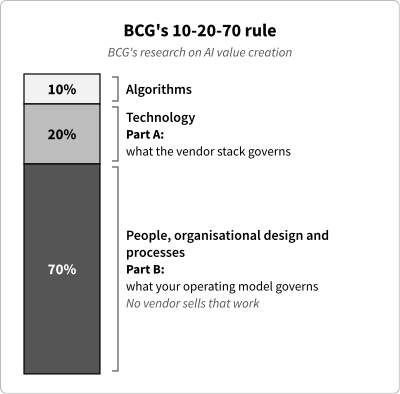
Under BCG’s 10-20-70 rule, a technically sound implementation covers the algorithms and the technology and leaves the 70% untouched. That 70% comes from organisational decisions: how outcomes are owned and how accountability flows when something goes wrong. Enterprise agent platforms supply the controls for the 20%. They cannot make the operating model decisions in the 70%: what each agent is authorised to produce, and which governance forum can constrain its scope.
Vendor platforms cannot own accountability
No vendor can decide, on your behalf, who is accountable when an agent in your finance function produces an output your CFO cannot defend to the board. Nor can a vendor set the escalation pathway for a mandatory sponsor who is not equipped to review the output the agent was authorised to produce.
The vendor’s mandatory sponsor requirement puts a person’s name against every agent in the register. That person answers for the agent only once they hold the authority to change its scope and the information to judge its output, and the platform supplies neither. The Deloitte AI Institute found that 84% of companies have not redesigned jobs or the nature of work around AI capabilities. Only 21% report having a mature model for governing autonomous agents (Deloitte AI Institute, 2026). Without a mature governance model, the vendor’s controls record what each agent did, and no decision says what it was for or whose job it is to defend it.
Gartner predicts that by 2027, 40% of enterprises will demote or decommission autonomous AI agents due to governance gaps identified only after production incidents (Gartner, 2026). By 2026, 40% of enterprise applications are expected to be integrated with task-specific AI agents, up from less than 5% the year before (Gartner, 2025). Each agent added before the operating model decisions are made goes live with a sponsor and no decided scope. The longer those decisions wait, the more of the enterprise’s agents run outside a designed accountability model, each one exposed to the demotion Gartner predicts after production incidents.
What the CIO now initiates
The governance briefing your board is asking for has two parts, and the distinction determines whether the audit examines a governance model or the absence of one.
Part A is the account of what the vendor stack governs. This account can be drawn from platform documentation and identity telemetry: agent registration, sponsor assignments, policy inheritance, session logs, and traffic monitoring coverage. For most enterprise deployments through a major agent platform, this account is available and can be made credible. It represents the 20%.
Part B is the account of what your operating model governs. This is where the decisions your leadership team has made, or has not made, determine what the board learns. What outcomes are agents authorised to produce on behalf of your organisation? Who holds the authority to adjust that scope as agent capability evolves? What is the governance pathway when an agent’s output requires human review before action is taken? Who answers to the board for an agent while those questions have no defined answer?
The CIO who can deliver Part B has done the operating model work the governance briefing asks about. That work assigns each agent’s outcomes to a single, accountable owner and designates which governance forums hold authority to manage agent scope. It also builds the escalation route a sponsor uses when an output needs human review before anyone acts on it. No vendor sells that work and no platform audit trail records it, yet it is the part of the account your board is asking for.
What this means for senior leaders: Your vendor platform gives every agent a registration and a mandatory sponsor, and neither decides what that agent is authorised to produce. That decision belongs to your leadership team, and each agent deployed before that decision is made goes live with a sponsor and no decided scope. A sponsor answers for an agent only with the authority to change its scope and the information to judge its output, so the CIO’s work is to grant both. Assigning each agent’s outcomes to a single owner, and naming the governance forum that can constrain its scope, turns the names in the agent register into people who can answer to the board.
The vendor’s controls answer Part A of the board’s question; only what your organisation has decided about each agent’s scope and owner answers Part B. The CIO who brings both accounts to the board can initiate the operating model design before the audit begins and give the auditors decisions to examine.
References
- Cloud Security Alliance. (2026, April 3). The AI Agent Governance Gap: What CISOs Need Now. CSA Labs. https://labs.cloudsecurityalliance.org/research/csa-research-note-ai-agent-governance-framework-gap-20260403/
- Deloitte AI Institute. (2026). State of AI in the enterprise: The untapped edge. Deloitte. https://www.deloitte.com/content/dam/assets-shared/docs/about/2025/state-of-ai-2026-global.pdf
- Gartner. (2025, August 26). Gartner predicts 40% of enterprise apps will feature task-specific AI agents by 2026, up from less than 5% in 2025 [Press release]. https://www.gartner.com/en/newsroom/press-releases/2025-08-26-gartner-predicts-40-percent-of-enterprise-apps-will-feature-task-specific-ai-agents-by-2026-up-from-less-than-5-percent-in-2025
- Gartner. (2026, May 26). Gartner says applying uniform governance across AI agents will lead to enterprise AI agent failure [Press release]. https://www.gartner.com/en/newsroom/press-releases/2026-05-26-gartner-says-applying-uniform-governance-across-ai-agents-will-lead-to-enterprise-ai-agent-failure
- Microsoft. (2026, May 5). 2026 Work Trend Index annual report: Agents, human agency, and the opportunity for every organization. WorkLab. https://www.microsoft.com/en-us/worklab/work-trend-index/agents-human-agency-and-the-opportunity-for-every-organization


