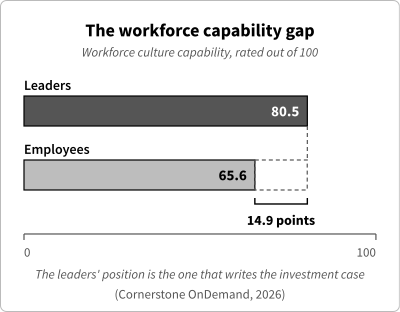
In December 2025, a YouGov survey of 452 leaders and 780 employees across Australia and New Zealand (ANZ) measured workforce culture capability across six capability pillars. Leaders rated it at 80.5 out of 100; employees rated the same workforce at 65.6. Both groups were measuring the same organisations, and the workforce capability gap between their readings was 14.9 points (Cornerstone OnDemand, 2026).
In Brief
- ANZ leaders rated workforce capability at 80.5/100 and employees rated it at 65.6, a 14.9-point gap.
- An AI investment case that takes its capability baseline from its sponsors starts from the leaders' higher rating.
- 96% of HR leaders report confidence in AI readiness; fewer than half of employees agree.
- A case planned on the leaders' rating under-funds training and change management, and each later cycle repeats the shortfall.
- Testing the baseline against the workforce's own account before scope is set changes what the investment addresses and sizes it for the people who will use it.
The two readings come from different positions in the organisation, and the leaders’ position is the one that writes the investment case.
Where the investment numbers come from
Business case baselines for workforce capability investment are drawn from the group closest to the investment decision: the leaders who sponsor it and the executive committee that approves it. The Cornerstone survey shows that leaders, as a group, rate workforce capability 14.9 points above what the workforce reports.
Leaders observe the capability that reaches them: the high performers who present in briefings and the project teams whose results appear in reporting. That subset is stronger than the workforce as a whole. The sponsor’s observation is accurate for what reaches the executive table, and it reads high for the workforce the investment has to reach.
The Cornerstone survey also asked employees directly, which a business case built on leaders’ ratings does not. Fewer than half of employees across the ANZ study agreed that their organisation was AI-ready. In the same survey, 96% of HR leaders reported confidence in AI readiness (Cornerstone OnDemand, 2026). The HR leaders’ confidence reflects what is visible from their position: the investments approved and the governance structures in place. The workforce’s view reflects what is available at the team level on an ordinary working day.
An investment case that takes its capability baseline from leaders inherits a reading 14.9 points above the workforce’s own. Leaders rate the capability that reaches the executive table, and the strongest work is what reaches it.
The condition persists because it does not require any deliberate choice to produce it. Any investment decision that draws its capability baseline from the same group that sponsors the investment will produce a reading weighted toward that group’s experience. Well-run organisations produce the gap as reliably as any other: capable senior teams and good upward reporting are the channels that carry the strongest work to the top. The gap comes from where leaders sit, so better leaders do not remove it.
Where the group that assesses workforce capability also sponsors the investment designed to act on it, nothing in the approval path separates the two. The executive who approves the AI deployment budget has then already judged the workforce ready for it, from the same position and on the same view, before anyone has asked the workforce.
A national security agency that implemented a product operating model had assigned product manager roles across teams: the titles were present, and the accountability language was in the governance documentation. What the operating review found was that core concepts of product ownership were nominally assigned but not functionally supported. The decision governance and prioritisation mechanisms that would allow a product manager to act on their accountability were absent (Zen Ex Machina, n.d.). The agency had funded a significant program against a capability assessment that was correct on paper, and the capability did not operate in practice.
How the 15-point gap distorts scope
An investment case set against a capability baseline 14.9 points above the workforce’s own rating plans its scope for a workforce more capable than the one it has to reach. Its change management budget is lighter, and its adoption timeline assumes faster uptake than that workforce will produce.
Uptake then runs slower than the business case projected, and training and change management cost more than it allocated. These overruns read as implementation friction, and some of them are. When the overruns run consistently the same way, with the workforce needing more than the investment provided for, they point to the baseline the case was built on rather than to its execution.
HR leaders’ confidence in AI readiness runs at 96%, while fewer than half of employees share it (Cornerstone OnDemand, 2026). An organisation that sets AI deployment scope on the HR leaders’ numbers is designing for a workforce its own investment case does not describe. Each deployment cycle planned on the leaders’ picture adds training and change work the case did not fund, and the next cycle is planned from the same picture. The shortfall grows with each cycle until the organisation changes how it measures capability or the shortfall becomes large enough to be reported to the executive committee.
Cornerstone’s data attributes AUD $1.64 million in annual cost per 1,000 employees to unaddressed workforce culture and capability issues. Approximately 85% of it comes from retention and absenteeism rather than from hiring costs (Cornerstone OnDemand, 2026). That cost keeps running after an investment planned on the higher baseline has ended. The program was scoped for the capability leaders reported, and the shortfall the workforce reports is still there.
What the business case never asks
Both readings are accurate, and the investment case needs both: the leaders’ account of the work that reaches the top, and the workforce’s account of what is available at team level on an ordinary working day.
Before the investment committee approves the case for an AI deployment or a workforce transformation, the capability picture it rests on should be tested against what the workforce itself reports. The test uses the workforce’s own account, gathered directly from employees rather than reported up through the leaders who sponsor the investment.
What this means for senior leaders: The capability baseline in your investment case comes from where the investment decision is made. The Cornerstone survey puts the leaders’ rating 14.9 points above the workforce’s own. Testing that baseline before scope is set keeps the investment and aims it at the gap the workforce reports, with its training and change budget sized for the workforce that will use it.
An investment case that takes its capability baseline only from leaders has already received an answer, from the group most invested in the outcome. The executive who adds the workforce’s own account before scope is set approves a program sized for the workforce it has to reach.
References
- Cornerstone OnDemand. (2026, May 21). ANZ organisations losing millions annually due to workforce culture and capability gaps, Cornerstone report finds [Press release on the report The Hidden Number: The Economic Value of Culture and Capability]. Cornerstone OnDemand. https://www.cornerstoneondemand.com/company/news-room/press-releases/anz-organisations-losing-millions-annually-due-to-workforce-culture-and-capability-gaps-cornerstone-report-finds/
- Zen Ex Machina. (n.d.). National security agency: 3x productivity from a 12-week Product Operating Model [Case study]. Zen Ex Machina. https://zenexmachina.com/case-studies/national-security-agency-product-operating-model/


